
Technology
There are several 3D scanning technologies that are used to create digital 3D models of real objects or places. Some of these technologies are:
- Laser scanning: This type of 3D scanning uses a laser beam to illuminate an object and measure distances from the scanner to the object using reflections of the laser light. Laser scanning is fast and capable of capturing a large amount of detail, but can be affected by reflections or scattering of the light.
- Photogrammetry: Photogrammetry creates 3D models by capturing photographs of an object or space from different angles and then using mathematical algorithms to create a 3D model from these photographs. Photogrammetry is useful for scanning objects with less detail or for scanning objects or locations that are too large or far from the scanner for a laser scanner.
- Structured light: Structured light creates 3D models by projecting structured light onto an object and measuring how the light bounces back. This type of 3D scanning is capable of capturing a large amount of detail and is suitable for scanning objects with surfaces that are prone to reflections or light scattering for laser scanning.
- CT 3D scanning: CT (Computed Tomography) 3D scanning is an imaging technique used to create 3D models of the internal structures of various objects (parts, products, archaeological finds, etc.). CT scanning uses X-rays to create a series of images of internal structures from different angles and then uses mathematical algorithms to create a 3D model from these images.
- Contact scanning: Contact scanning creates 3D models by touching the surface of an object and measuring its shape and depth using a touch sensor. This type of 3D scanning is slow but very accurate. It is often used in product accuracy verification or reverse engineering.
- Radar scanning: Radar scanning creates 3D models by sending radio waves at an object and measuring the time it takes for the waves to bounce back. This type of 3D scanning is capable of capturing a large amount of detail and is suitable for scanning objects or locations that are too large or far from the scanner for laser scanning or structural light.
Choosing the right 3D scanning technology depends on the specific application and specifications such as the required accuracy and resolution, size, complexity and surface of the object or area to be scanned. We most often use the first two technologies, or a combination of them, but we can also provide, for example, the scanning of internal parts of various industrial products on a CT scanner.
Laser 3D scanning (lidar)
Leica RTC360
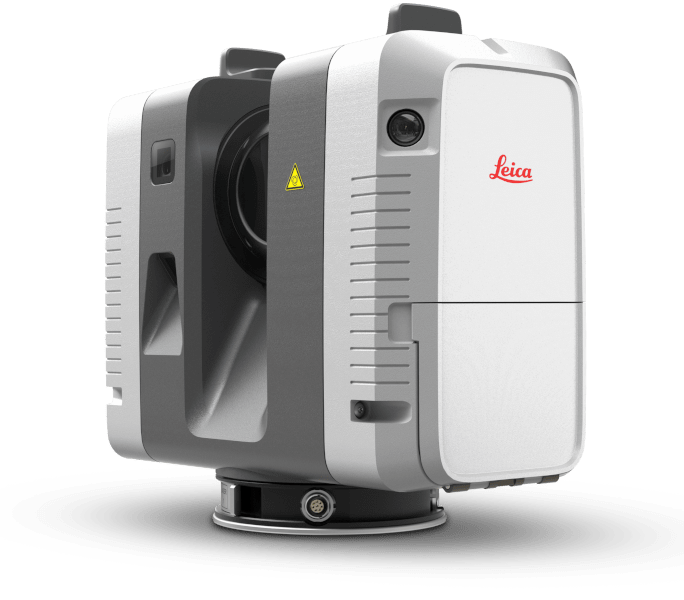
Specifications:
- Class 1 laser (safe under all conditions)
- Accuracy up to ±1.9mm
- Range up to 130m
- HDR photography (432 MPx RAW data)
- Integrated GPS receiver
- Integrated compass
- Height sensor
- Scanning in direct sunlight
- Use for both exteriors and interiors
- Very fast scanning (2x - 3x faster than Faro)
Especially suitable for:
- Scanning of buildings and entire building complexes, historical monuments, film sets, larger-than-life statues, etc.
- Digitization of cultural heritage
- Reverse engineering, obtaining plans for buildings for which no documentation is available or documentation does not correspond to reality
- Documentation of the condition of the building, documentation of reconstruction works, comparison of the condition before and after reconstruction
- Verification of the actual condition (whether the building corresponds to the documentation)
Faro Focus X330
Specifications:
- Class 1 laser (safe under all conditions)
- Accuracy up to ±2mm
- Range from 0.6m to 330m
- Integrated GPS receiver
- Integrated compass
- Height sensor
- Scanning in direct sunlight
- Use for both exteriors and interiors
Especially suitable for:
- Scanning of buildings and entire building complexes, historical monuments, film sets, larger-than-life statues, etc.
- Digitization of cultural heritage
- Reverse engineering, obtaining plans for buildings for which no documentation is available or documentation does not correspond to reality
- Documentation of the condition of the building, documentation of reconstruction works, comparison of the condition before and after reconstruction
- Verification of the actual condition (whether the building corresponds to the documentation)

ZEISS T-SCAN hawk
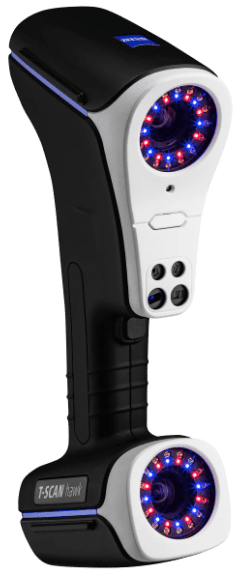
Specifications:
- Class 2 laser (eye-safe)
- Infrared and blue laser in one
- Accuracy up to ± 0.02 mm
- Resolution down to 0.01 mm
- Volume accuracy 0.020 mm + 0.030 mm/m
Especially suitable for:
- Scan smaller to medium-sized parts - approx. from coin size to car size
- Automotive - scanning of car parts, engines, car bodies, car seats, interior parts, etc.
- Construction - scanning of decorative cornices, ornaments, sculptures for the production of templates or copies
- Metrology - dimensional and absolute inspection of parts, verification of product accuracy (comparison of the manufactured piece with the CAD model)
- Reverse engineering
- Digitization of cultural heritage
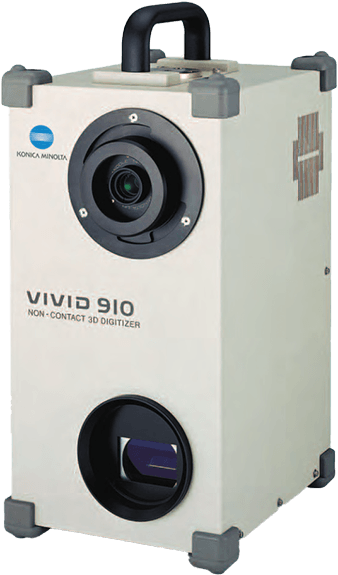
Konica Minolta Vivid 910
Specifications:
- Class 2 laser (eye-safe)
- Accuracy to X: ± 0.22mm, Y: ± 0.16mm, Z: ± 0.10mm
- Range (depth of field) from 0.6m - 2.5m
- Interchangeable lenses for scanning different sized objects
Especially suitable for:
- Scanning of smaller objects - approx. human size
- Automotive - scanning of car parts, engines, car bodies, car seats, interior parts, etc.
- Metrology - dimensional and absolute inspection of parts, verification of product accuracy (comparison of the manufactured piece with the CAD model)
- Reverse engineering
- Digitization of cultural heritage
Photogrammetry
Sony A7R
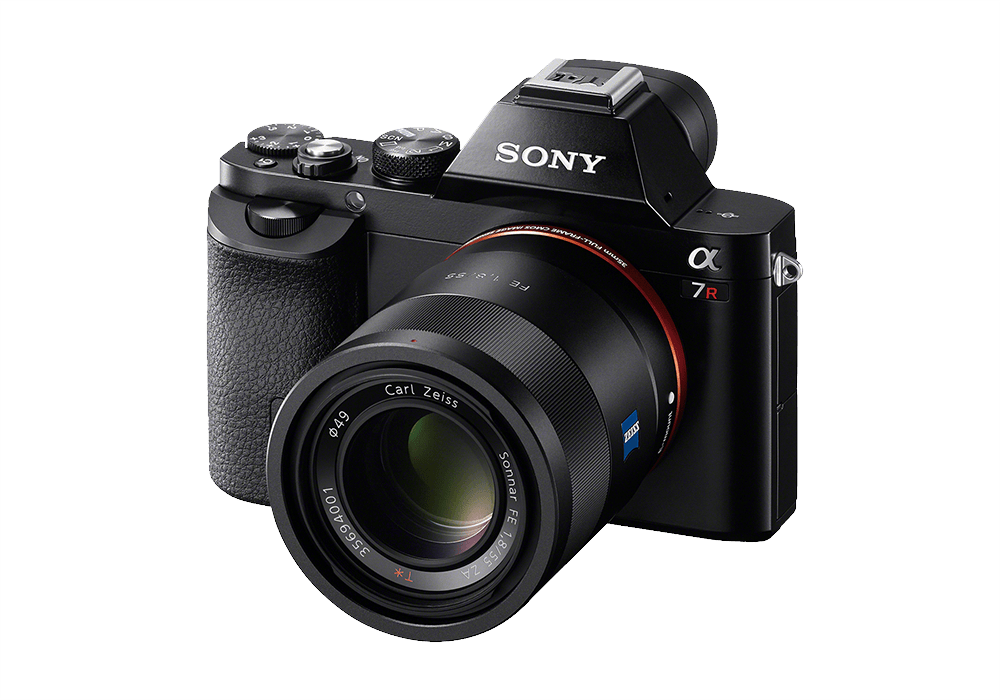
Specifications:
- Fullframe sensor
- Resolution 36Mpx
- Multiple lenses covering focal lengths from 14mm to 300mm
- Excellent dynamic range
- Arduino-controlled turntable for automatic scanning of small objects
- Applicable for objects of all sizes
Differences
Laser scanning
Pro:
- calibrated equipment, certified very high accuracy
- naturally in the right size
- seamless scanning of objects without contrast points
Against:
- texture in low resolution and with bad colours (some scanners do not scan the colour at all)
- Difficult to scan narrow spaces
- it is usually not possible to capture elevated areas (e.g. roofs)
- more expensive than photogrammetry
- limited laser beam range
- the resolution decreases relatively quickly with increasing distance
Certified accuracy
Precise scale
Photogrammetry
Pro:
- great texture quality
- easier scanning of narrow spaces
- basically no size limit. Technically, with the proper photogrammetry equipment, anything from sub-millimeter objects to entire planets can be scanned
Against:
- need to set the scale manually (room for error)
- less accuracy, no certification
- distortion of shape caused by lens distortion
- if the scanned object does not have a sufficiently contrasty texture, the resulting model has very significant surface noise (typically monochrome facades of houses)
Texture quality
Narrow spaces
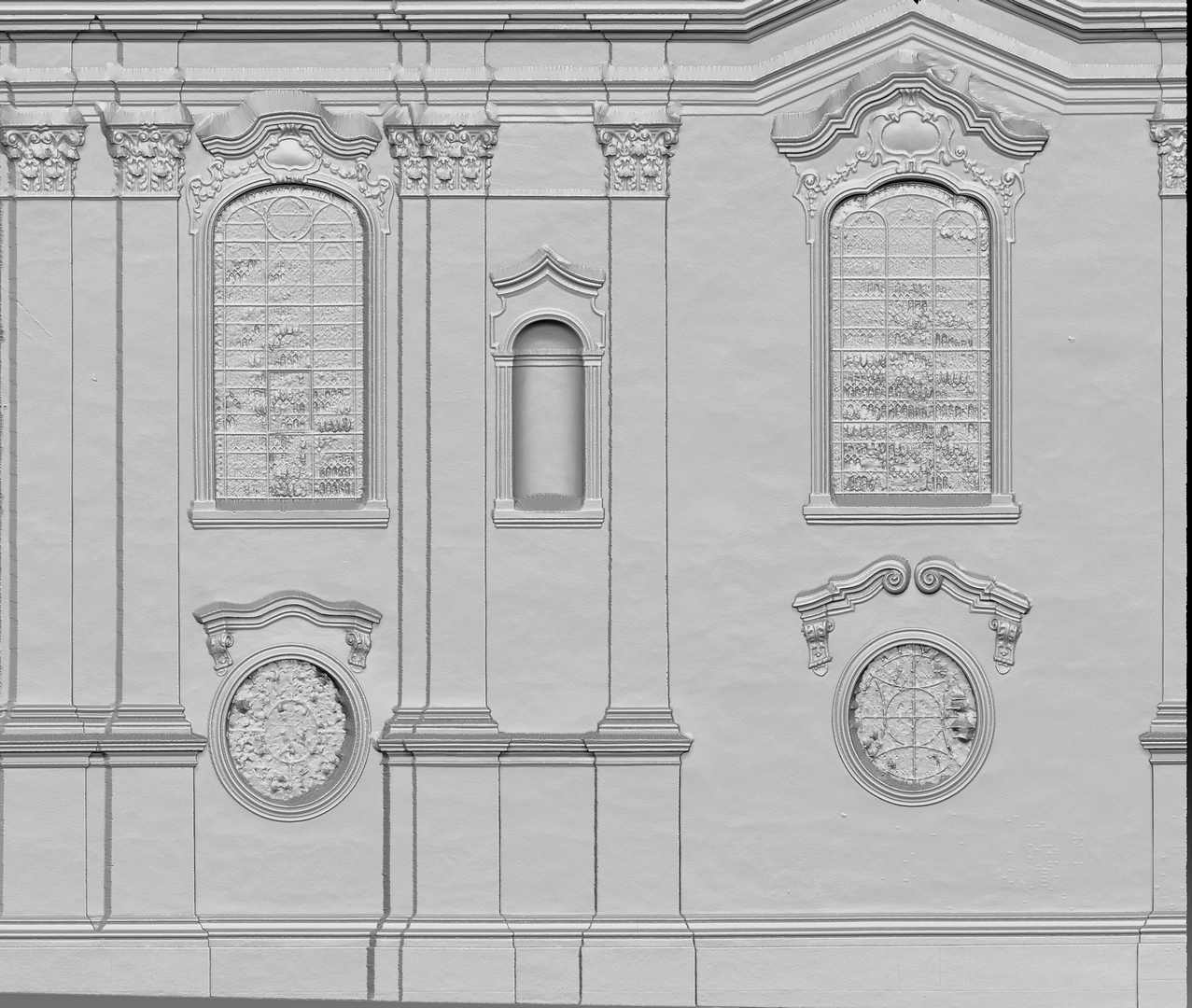
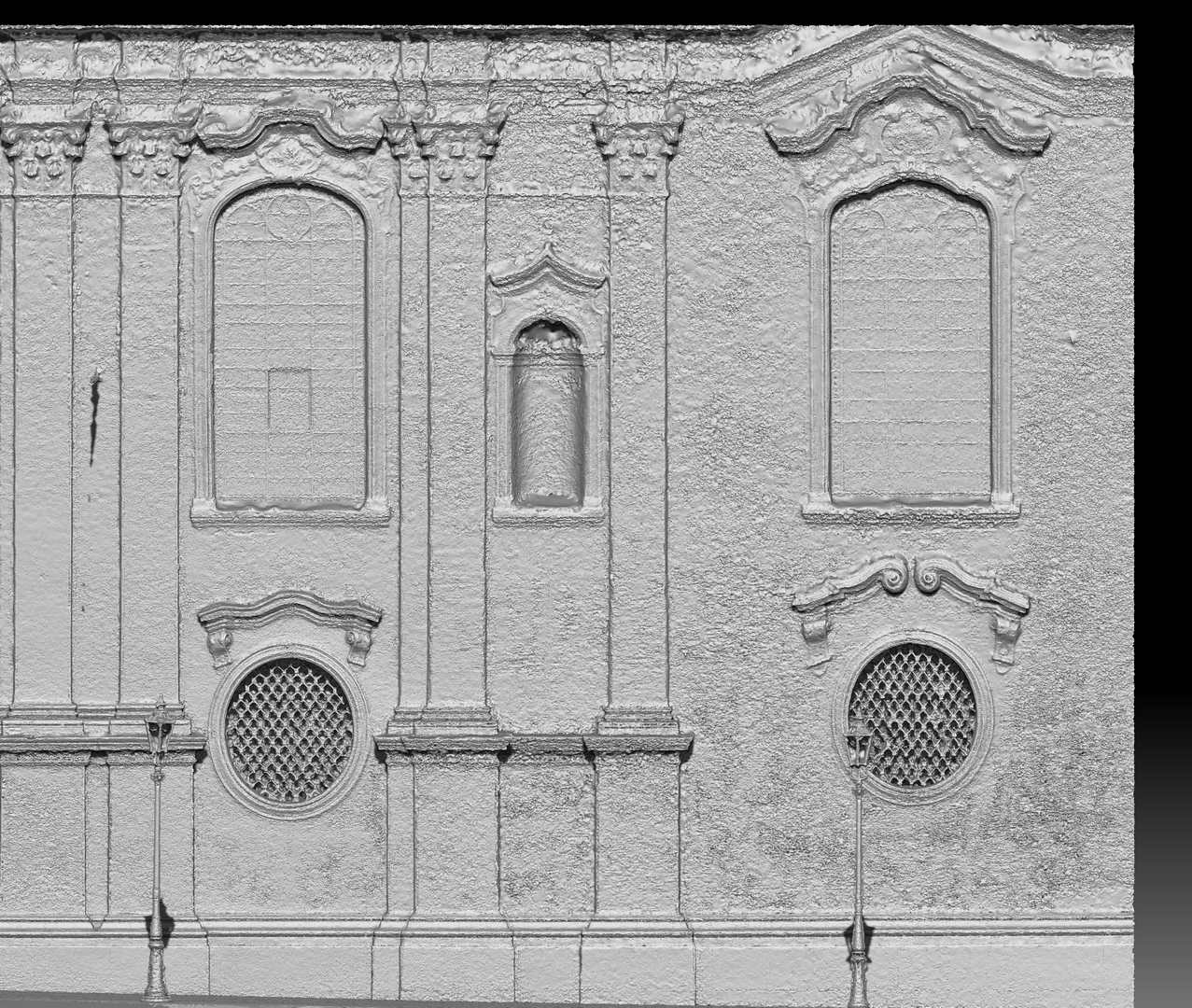
Combination both methods
Pro:
- highest precision
- best coverage
- the best texture
Against:
- longest processing time
- the most expensive method
Parameters output models
- Depending on the size of the project, the original undecimated mesh can have more than 1 billion polygons
- Texture resolution up to 16384×16384. No limit on the number of textures
- All standard formats (OBJ, FBX, Maya...)
Up to billions of polygons
16k textures with no limit on quantity
All standard formats
Price
Unfortunately, it is not possible to set a flat price for 3D scanning, because it is strongly dependent on what is the subject of the scan, what accuracy and resolution the scans should be in, what scanning technology is used, etc. It can therefore range from a few thousand for smaller objects scanned by photogrammetry to hundreds of thousands for large buildings scanned by a combination of multiple technologies. The price is therefore determined individually for each job based on your request. To get a quote, please contact us by email, phone or via the contact form.